Materiality 1
Contribute to Environmental Conservation
As a comprehensive manufacturer of nonferrous metals and advanced materials, the JX Advanced Metals Group is rising to the challenge of innovation in the productivity of resources and materials. Committed to compliance with environmental regulations, our policy is to proactively strive for environmental conservation on a global scale, including measures against global warming, and contribute to building a sustainable society. We also set the following KPIs to ensure steady progress on these efforts.
■ KPIs and Progress
Assessment: Achieved / Steady Progress Not Achieved
| KPI | FY2024 Results/Progress | Self-Assessment |
|---|---|---|
| Implement initiatives to increase the percentage of recycled raw materials and expand the breadth of recycled materials to be treated |
We worked to increase processing of recycled raw materials by expanding facilities and researching and testing new processes. We advanced discussions with various customers involved in copper use to develop a detailed transaction scheme involving the increased collection of recycled raw materials, aiming for the social implementation of two types of 100% recycled electrolytic copper (PCL100/mb and MR100/mb) produced using the mass balance approach. |
|
| Landfill disposal rate: Less than 1% in fiscal 2024 | We set a goal of keeping our landfill disposal rate at no more than 1%* to cut down on waste with the aim of minimizing our impact on the environment. Our landfill disposal rate in fiscal 2024 was 0.46%.
|
|
| Implement initiatives to achieve a 50% reduction in total in-house greenhouse gas emissions by fiscal 2030 (vs. fiscal 2018), and achieve net zero emissions in fiscal 2050 |
We continued our activities towards our goal by using CO2-free electricity at each site and exploring the introduction of new technologies. We also formulated a decarbonization vision through the Carbon Free Committee and announced the measures the Group will implement to achieve net zero emissions. |
The Three Pillars of Global Environmental Conservation
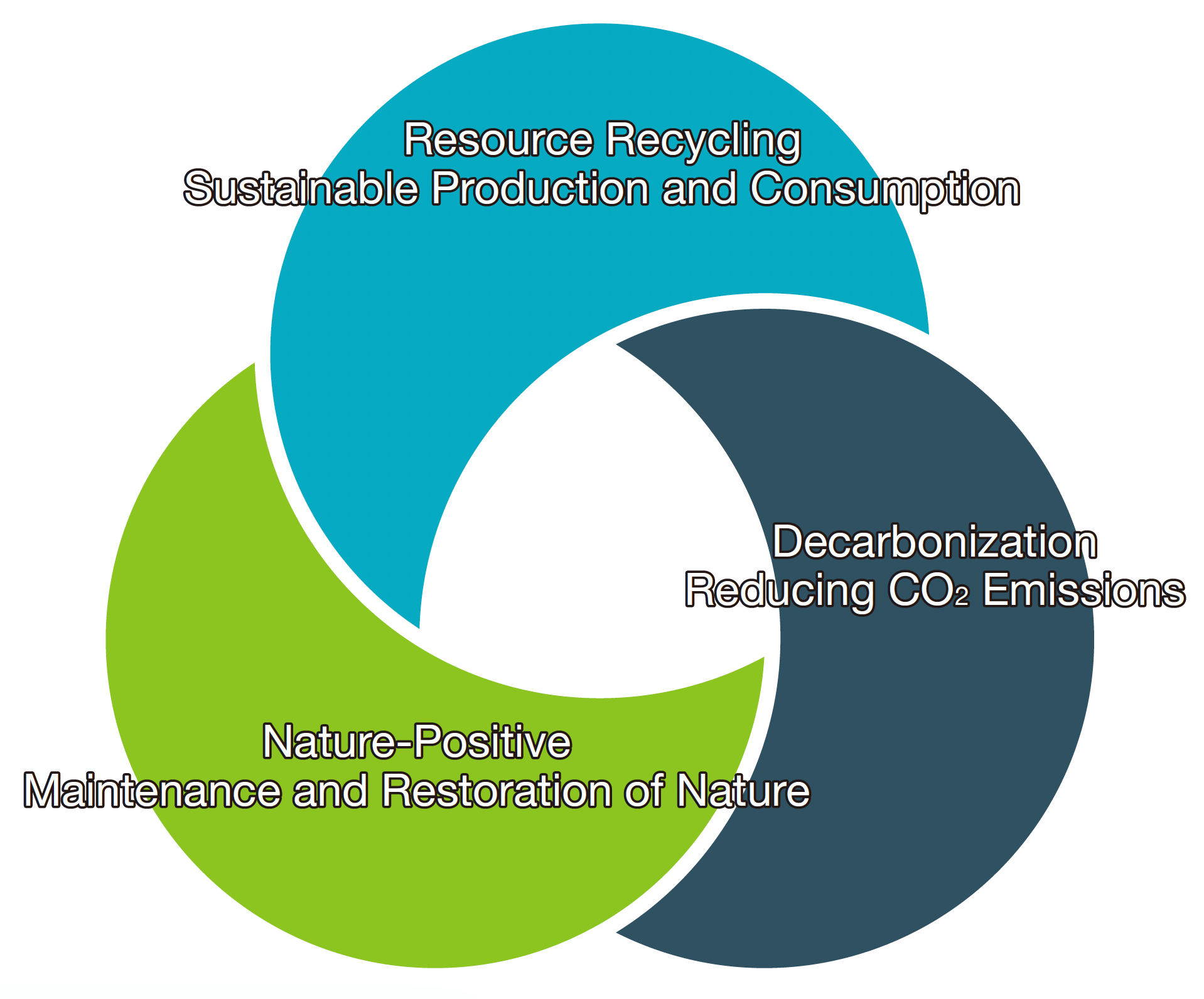
Efforts to protect the global environment now require action in three areas: resource recycling, decarbonization, and Nature-Positive initiatives. These areas build on the long-standing initiatives of air pollution control, water quality protection, and reforestation.
Resource recycling reduces resource extraction, and decarbonization mitigates climate change. Both actions avoid and/or limit environmental impact and connect closely to achieving Nature-Positive initiative outcomes.
Effective environmental conservation requires an integrated approach that recognizes the interrelationships among resource recycling, decarbonization, and nature positive themes, rather than addressing each theme separately.
Our group has established resource recycling, decarbonization, and Nature-Positive initiatives as the three pillars of our initiatives for global environmental conservation. We advance these pillars in an integrated manner under our Basic Environmental Policy.