


Respect Human Rights
in Supply Chains
In all of our business activities, the Group respects the fundamental human rights of our own employees and all those involved in our supply chain, and at the same time, we strive to mitigate potential human rights risks.
JX Advanced Metals Group Basic Policy on Procurement (Excerpt)
- 5.Approach to Conflict Minerals
- ●Do not engage in raw materials procurement that contributes to illegal activities in conflict-affected regions or to human rights violations resulting from such activities.
- ●Respect the guidance of the Organization for Economic Co-operation and Development (OECD) related to raw materials procurement from conflict-affected areas, and control supply chains in an appropriate manner.
Policy for Selecting Procurement Partners
In the conduct of our business operations, it is necessary, not only that we in the JX Advanced Metals Group fulfill our responsibilities to society, but that our business partners do the same across their own supply chains. Therefore, we also require our business partners to operate in accordance with the items below. Going forward, we will confirm the process of improvement with respect to business partners who violate the items below and receive an adverse disposition from the government, as well as business partners found not complying with the items below. Furthermore, in the case that a business partner is not complying with the items below, we consider whether it is necessary to review (or cancel) the contract with the business partner.
- 1.Comply with laws, regulations, and social norms, such as those below, and place priority on human rights and environmental impact. In the event of any inconsistencies between internationally-recognized human rights principles and the laws, regulations, social norms, etc., respect the international human rights principles.
- ●Obey laws and regulations related to manufacturing and sales, etc.
- ●Comply with labor-related laws and regulations
- ●Comply with laws and regulations related to health and safety and facilitate appropriate working environments
- ●Prohibit child labor and forced labor
- ●Prohibit discrimination based on race, gender, etc. and respect the human rights, personality, and individuality of employees
- ●Comply with environmental laws and regulations
- ●Prohibit bribery and other unfair conduct
- ●Do not engage in conflict minerals procurement or use that contributes to inhumane acts
- ●Preclude all relations with "antisocial forces" (the term used to refer to organized crime groups in Japan)
- ●Ensure proper management of personal information and business partner information
- 2.Engage in sound and fair business management.
- 3.Set goals to achieve carbon neutrality to address climate change issues, and take active measures to meet these goals.
- 4.Based on the JX Advanced Metals Group's Green Purchasing Guideline, build environmental management systems and properly manage specified chemical substances.
- 5.Offer stable supply capacity and satisfy the quality, price, delivery, and service requirements of the JX Advanced Metals Group.
- 6.Possess technological capabilities that meet the requirements of the JX Advanced Metals Group.
Initiatives for Human Rights in the Supply Chain
In accordance with the Basic Policy on Procurement, the Group conducts checks with our suppliers about issues such as ensuring worker rights, the presence of discrimination in hiring and work, forced labor and child labor, and compliance with prohibition against purchasing conflict minerals.
We also conduct the CSR Procurement Questionnaire to foster CSR in procurement across our entire supply chain.
We will continue to conduct these questionnaires and provide feedback to our suppliers, while at the same time taking precautions to prevent human rights violations from occurring in our supply chain.
Prohibition of Forced Labor, Child Labor, and Discrimination
Our Group Policy for Selecting Procurement Partners extends to our supply chain and stipulates that forced labor, child labor, racial discrimination, and gender discrimination are prohibited and that there is to be compliance with all labor laws and regulations. Neither in the Group nor among our suppliers have there been any reported cases of forced labor, child labor, violations of freedom of association, factory shutdowns due to strikes, or employment discrimination. Going forward, we will continue our efforts to prohibit forced labor, child labor, and discrimination of all kinds.
TANIOBIS Japan Mito Plant Receives Platinum Status in RBA Audit
RBA-issued VAP audit certificates
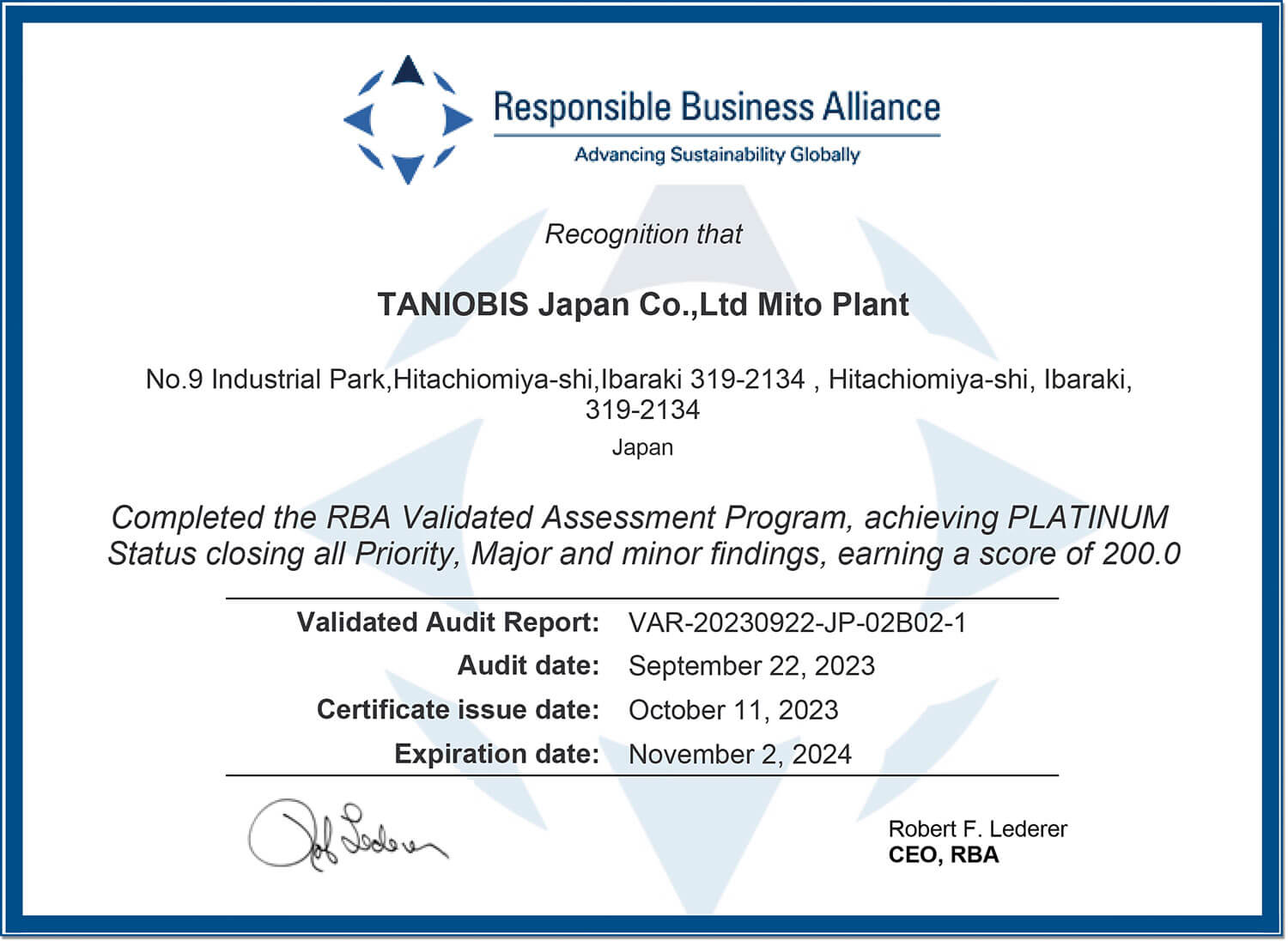
The TANIOBIS Japan Mito Plant received a perfect score of 200 points in the Validated Assessment Program (VAP) audit, which evaluates compliance with the Responsible Business Alliance (RBA) Code of Conduct. This score earned the plant platinum status, the highest status in the RBA certification program.
The Mito Plant is the third site to receive Platinum Status in the RBA audit, following Isohara Works (April 2022) and the Chigasaki Plant of Toho Titanium Co., Ltd (June 2021). We believe this status depicts the steady progress of our group-wide efforts to promote ESG and serves as proof of the transparency of our semiconductor material supply chains.
- *1Responsible Business Alliance (RBA): A business alliance created with the goal of realizing responsible behavior in the electronics industry supply chain.
Confronting the Problem of Conflict Minerals
“Conflict minerals” is the general term for minerals that are mined (illegally, in most cases) in conflict-affected regions, providing a source of funds for local armed groups. The use of these minerals may lead to increasing human rights violations and inhumane acts. In response to the international trend for stronger information disclosure and monitoring by stakeholders, industry organizations relevant to the Group (including the LME*1, LBMA*2, LPPM*3, and RBA) have established monitoring programs for eliminating conflict minerals, and require each business operator to undergo investigations and external audits.
- *1London Metal Exchange (LME): A global center for industrial metal trading, where the majority of all non-ferrous metal, including copper, are traded through futures contracts.
- *2London Bullion Market Association (LBMA): An industry association composed of financial institutions and others that deal in gold and silver ingot. Inclusion on this association's Good Delivery List is viewed as a guarantee of high quality and reliability.
- *3London Platinum and Palladium Market (LPPM): An industry association composed of financial institutions and others that deal in platinum and palladium ingot. Inclusion on this association’s Good Delivery List is viewed as a guarantee of high quality and reliability.
Initiatives in Copper, Gold, Silver, Platinum, and Palladium Supply Chains
JX Metals Smelting Co., Ltd. established a management system for supply chain due diligence that includes the following activities:
1. Conducting supply chain due diligence before purchasing raw material minerals
2. Informing suppliers of our policy to exclude conflict minerals
3. Providing internal education on supply chain due diligence and background
4. Conducting internal audits and undergo external audits
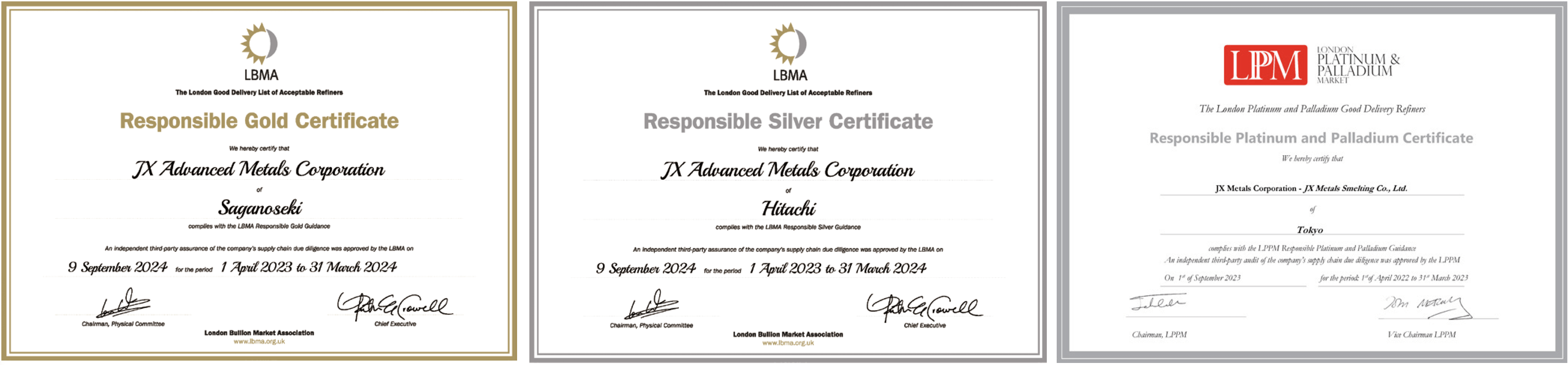
A third-party assurance provider approved by LBMA and LPPM assesses our supply chain due diligence operations, and we report these assessment results to LBMA and LPPM. Both organizations list the gold, silver, platinum, and palladium sponges produced by JX Metals Smelting Co., Ltd. on their Good Delivery List through this process. At the same time, Saganoseki Smelter & Refinery and Hitachi Works appear on the RMAP Conformant Smelters list. This list identifies smelters that do not use conflict minerals, and was established by the RBA and the Global e-Sustainability Initiative (GeSI)*1.
JX Advanced Metals also established a supply chain due diligence management system for copper cathodes and under-goes third-party audits through the Copper Mark certification process.
- *1Global e-Sustainability Initiative (GeSI): A global organization of European telecommunications industry associations. RBA and GeSI, both involved in this industry, jointly developed the Responsible Minerals Assurance Process (RMAP) certification program in response to the high risk of conflict minerals being used in electronic and telecommunications equipment.
LBMA- and LPPM-Issued External Audit Certificates
Initiatives for the Tantalum Supply Chain
TANIOBIS GmbH is a Group company that produces tantalum powder. This company conducts supply chain due diligence in accordance with international standards as a smelter of tantalum, a designated conflict mineral. TANIOBIS GmbH strives to prevent complicity in human rights violations in conflict-affected and high-risk areas.
The supply chain management of TANIOBIS GmbH received certification from RMI*1, an international framework for responsible mineral procurement, and was evaluated as an RMAP*2 Conformant Smelter.
- *1Responsible Minerals Initiative (RMI): An organization within the RBA that facilitates due diligence in the conflict minerals supply chain and provides programs to certify appropriate measures.
- *2Responsible Minerals Assurance Process (RMAP): A certification program for responsible mineral procurement established by RMI
Addressing the 2024 Logistics Problem
The 2024 Logistics Problem is an issue in Japan in which society faces a shortage of transport capacity. Our efforts to address the 2024 Problem include identifying and reducing on-site wait times and cargo-handling times, based on the recent revision of the Act on Advancement of Logistics Efficiency.
We are also securing sufficient lead times by requesting earlier transport arrangements and advancing the shift from truck transport to rail transport as part of our efforts to build sustainable logistics.